AI for wholesalers: a complete implementation and ROI guide for 2025
A practical guide to AI for wholesalers: order automation, demand forecasting, dynamic pricing and inventory management with measurable ROI.

Manuel Gros
Growth and Sales Advisor
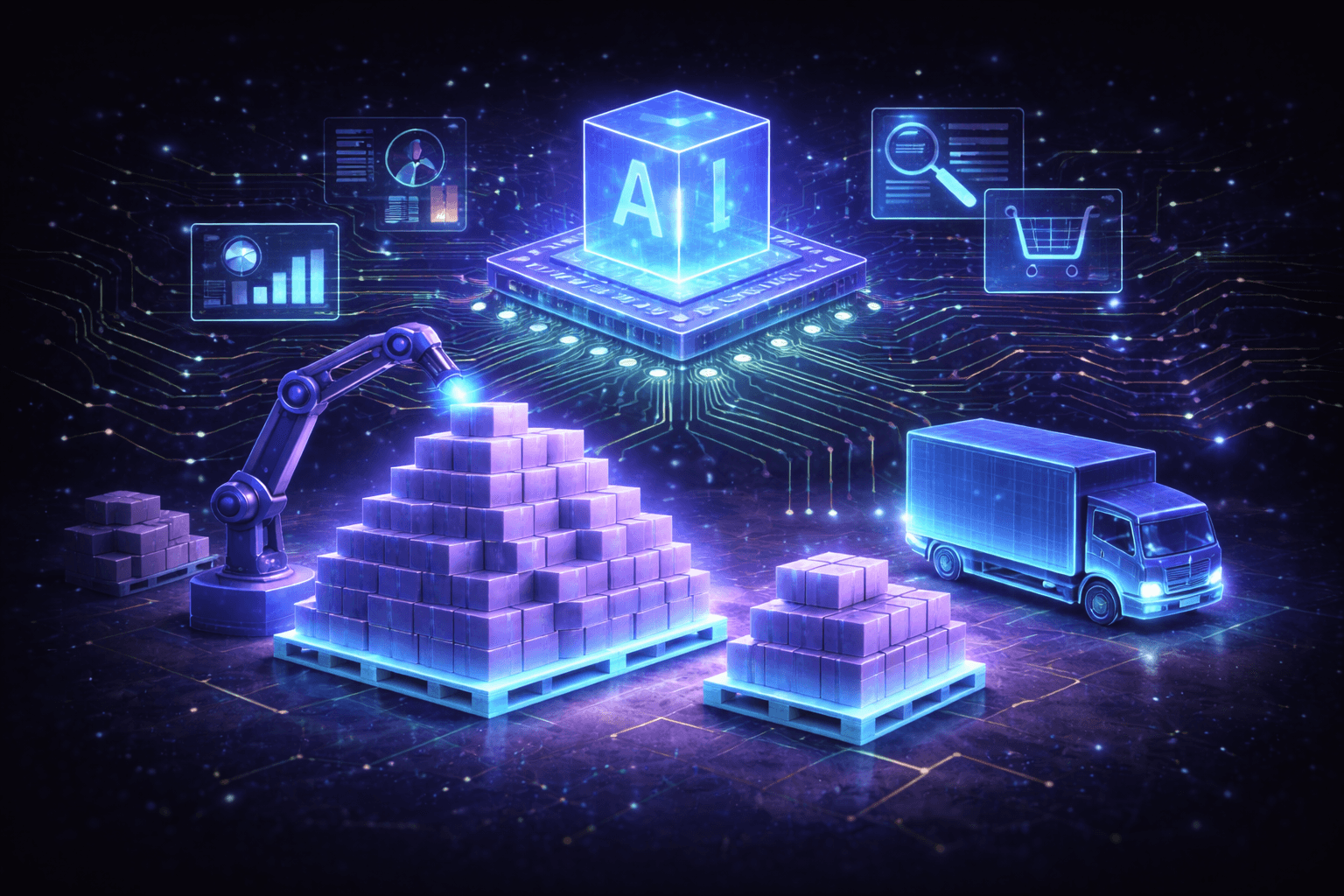
Digital transformation is no longer optional for wholesale distribution companies. In a market where margins are shrinking and competition is intensifying, artificial intelligence for wholesalers is emerging as the differentiating factor that makes it possible to optimize operations, anticipate demand and strengthen commercial relationships. This complete guide explores how to implement AI solutions strategically, from wholesale order automation to dynamic price optimization for wholesalers, with a clear focus on measurable return on investment.
1. Introduction and the AI-for-wholesalers landscape
The wholesale sector is at a technological inflection point. Companies adopting AI tools for wholesale sales are seeing significant improvements in operational efficiency, cost reduction and responsiveness to the market. Today's ecosystem offers mature solutions ranging from AI agents for wholesale procurement to predictive stock-turnover analysis systems, democratizing access to technologies that used to be within reach of large corporations only.
1.1. Key benefits and opportunities
Implementing AI in wholesale operations generates tangible benefits on several fronts. First, automating repetitive processes frees human resources for work of greater strategic value. AI demand forecasting systems for wholesalers make it possible to cut capital tied up in inventory by between 15% and 30% while maintaining optimal service levels. Chatbots and virtual assistants for wholesalers can handle customer queries around the clock, improving the buying experience and reducing response times. In addition, AI inventory management for wholesalers surfaces consumption patterns invisible to traditional human analysis, enabling better-informed decisions about assortment and stock levels.
1.2. Accessibility for SMEs and the competitive context
Contrary to common perception, AI is no longer the exclusive territory of large companies. SaaS solutions and cloud platforms have drastically lowered the barriers to entry. Today a wholesale SME can access predictive analytics, AI-driven automatic replenishment and AI route and logistics optimization without million-dollar investments in infrastructure. That democratization creates a new competitive context where differentiation does not depend on company size but on the ability to integrate artificial intelligence into core processes. Companies that ignore this trend risk losing relevance to more agile competitors.
1.3. Scope, representative cases and measured results
The measured results from successful AI implementations in the wholesale sector are compelling. Distributors of fast-moving consumer goods have reported 40% reductions in stockouts through predictive stock-turnover analysis. Industrial supply companies have cut logistics costs by 25% with AI route and logistics optimization systems. On the commercial side, B2B wholesalers implementing AI for prospecting and CRM have increased their lead conversion rate by more than 30%. These cases demonstrate that the ROI of AI is not speculative but verifiable.
2. Planning and analytics: forecasting, demand and pricing
The ability to anticipate market behaviour is one of the most valuable competitive advantages available to any wholesaler. AI turns historical data and market signals into actionable forecasts that make it possible to take proactive rather than reactive decisions.
2.1. Sales and demand forecasting with real-time data
Modern AI demand forecasting systems for wholesalers process multiple data sources simultaneously: sales history, seasonality, special events, online search trends and even weather data. That multidimensional analysis produces predictions significantly more precise than traditional statistical methods. Machine learning algorithms learn continuously from real results, refining their predictions with each cycle. For wholesalers with extensive catalogs, that means being able to manage thousands of SKUs at levels of precision that would be impossible to reach manually.
2.2. Scenarios and continuous strategy adjustment
AI-based planning is not limited to generating a single forecast. Advanced platforms make it possible to model multiple scenarios: what happens if a key supplier fails, how an aggressive competitor promotion would land, what adjustments a regulatory change requires. That simulation capability lets planning teams prepare contingency plans informed by data. Continuous adjustment is another key differentiator: while traditional plans are reviewed monthly or quarterly, AI systems can recalibrate projections daily, incorporating new information as it arrives.
2.3. Dynamic pricing and competitive analysis
Dynamic price optimization for wholesalers is one of the AI applications with the most direct impact on profitability. These systems analyse demand elasticity, competitor prices, inventory costs and margin objectives to recommend optimal prices by product, customer and moment. In B2B markets where negotiated prices are the norm, AI can suggest negotiation ranges that maximize the probability of closing without sacrificing margin unnecessarily. Automated competitive monitoring complements that capability, raising alerts about relevant price movements in real time.
3. Wholesale operations: inventory, logistics and returns
Operations are the heart of any wholesale business. Operational efficiency directly determines the ability to compete on price without sacrificing profitability. AI is redefining what is possible in inventory management, logistics and handling returns.
3.1. Inventory automation and optimal turnover
AI inventory management for wholesalers goes beyond simply calculating reorder points. Today's systems optimize turnover taking multiple variables into account: cost of capital, obsolescence risk, economies of scale in purchasing, storage capacity and target service levels by category. AI-driven automatic replenishment generates purchase orders that balance those factors, reducing both overstock and stockouts. Predictive stock-turnover analysis identifies products at risk of obsolescence before they become a problem, enabling preventive actions such as promotions or renegotiation with suppliers.
3.2. Logistics and AI-optimized routes
AI route and logistics optimization takes into account variables human planners simply cannot process simultaneously: delivery windows, vehicle capacity, real-time traffic conditions, customer priorities and access restrictions. The algorithms generate routes that minimize mileage and time, maximizing deliveries per trip. AI supply-chain monitoring complements that optimization, providing end-to-end visibility and early warnings about potential disruptions. For wholesalers with their own fleets, that can mean savings of 20% to 35% in distribution costs.
3.3. Reverse logistics and cutting the cost of returns
Returns represent a significant cost that many wholesalers underestimate. AI for returns management and reverse logistics optimizes that process across several dimensions: predicting products with a high probability of return, automatically determining the optimal disposition for each returned item, and optimizing collection routes. The most advanced systems can identify return patterns by customer, product or region, enabling preventive actions that reduce returns before they happen.
4. Sales and customer experience with AI
In the B2B wholesale environment, commercial relationships are fundamental. AI strengthens the ability of commercial teams to manage more accounts, identify opportunities and personalize each customer's experience.
4.1. Lead management and qualification in the CRM
AI for B2B customer segmentation and scoring transforms how commercial teams prioritize their time. Machine learning algorithms analyse multiple signals to identify which prospects have the highest probability of conversion and the greatest potential value. AI for prospecting and CRM in wholesale does not only qualify inbound leads; it can proactively identify companies whose profile resembles the best current customers. That combination of predictive scoring and active prospecting multiplies the commercial team's effectiveness.
4.2. Prospecting and commercial productivity
AI tools for wholesale sales are redefining commercial productivity. AI meeting summarization and transcription lets reps focus on the conversation while the system automatically documents commitments and next steps. Virtual assistants can prepare pre-meeting briefings consolidating purchase history, support tickets and the customer's recent activity. These tools significantly reduce administrative time, allowing more face-to-face time with customers.
4.3. Customer support with chatbots and personalization
Chatbots and virtual assistants for wholesalers have evolved dramatically. Today's systems can handle complex queries about availability, prices, order status and technical specifications. AI-based personalization makes it possible to adapt product recommendations and communications to each account's history and preferences. For wholesalers with customers across multiple time zones, the 24/7 availability of these assistants significantly improves the buying experience.
4.4. Churn prediction and retention
Churn and retention models for wholesalers identify early signals of disengagement: reduced order frequency, changes in product mix, an increase in support queries or a drop in email opens. That early identification allows proactive intervention before the account is lost. The most sophisticated systems do not only predict which customers are at risk; they recommend specific retention actions with the highest probability of success.
5. A step-by-step roadmap and checklist for implementing AI in wholesale
Implementing AI successfully requires a methodical approach that balances ambition with pragmatism. This roadmap provides a structured guide for maximizing the probability of success.
5.1. Initial assessment and defining objectives
The first step is identifying where AI can generate the greatest impact in your specific operation. Analyse your current processes looking for repetitive, time-consuming tasks, decisions that depend on large volumes of data, and areas where human variability creates inconsistency. Define measurable, realistic objectives: cut order processing time by 30%, improve forecast accuracy by 20%, or lift conversion rate by 15%. Clear objectives make it possible to evaluate ROI afterwards.
5.2. Designing and running pilots (MVP)
Start with narrow projects that can demonstrate value in weeks, not years. A pilot of wholesale order automation in a specific category, or a forecasting MVP for the 100 highest-turnover SKUs, makes it possible to validate the technology and generate learnings without compromising critical operations. Define success criteria before starting and set a clear timeline for evaluating results.
5.3. Metrics, ROI measurement and experimentation
Implement robust metrics from the start. Compare the results of processes with AI versus without AI under similar conditions. Calculate ROI considering not only direct savings but also costs avoided, service improvements and the value of the insights generated. Maintain a culture of continuous experimentation, testing new applications and refining existing ones based on real data.
5.4. Data preparation and governance for production
The quality of AI depends directly on the quality of the data. Before scaling, make sure your master data is clean, consistent and accessible. Establish governance policies that define ownership, quality and access to data. Integrating AI with the ERP and WMS is critical: make sure the data flows between systems are reliable and real time.
5.5. Organizational change, roles and training
Technology is only part of the equation. Success requires people to adopt new tools and new ways of working. Identify internal champions to lead adoption. Invest in training that is not only technical but also about understanding AI's capabilities and limitations. Adjust roles and responsibilities to capitalize on the new capabilities, focusing people on higher-value work.
5.6. Scaling, maintenance and the technology roadmap
Once the pilots are validated, plan the scale-up gradually. Define a technology roadmap that prioritizes initiatives by impact and feasibility. Establish maintenance and continuous monitoring processes: AI models require periodic retraining to hold their precision. Stay informed about technological developments so you can bring in new capabilities as they mature.
6. Procurement and sourcing driven by AI agents
AI agents for wholesale procurement are transforming the purchasing function, automating transactional work and strengthening strategic decisions.
6.1. Automating RFQs, orders and invoice reconciliation
Automatic invoice reconciliation with AI eliminates hours of manual work comparing purchase orders, receipts and invoices. The systems identify discrepancies automatically, escalating only the cases that require human intervention. Automated RFQ generation based on replenishment needs, and the creation of purchase orders that consolidate requirements to optimize volumes, complete a highly efficient procurement cycle.
6.2. Assisted negotiation and generative communications with suppliers
Supplier analysis and agentic negotiation is an emerging frontier. AI systems can analyse price history, market benchmarks and negotiation patterns to recommend strategies and negotiation ranges. Generative communications make it possible to draft negotiation emails, order follow-ups and incident handling, maintaining consistency and professionalism while freeing up the purchasing team's time.
6.3. Integration with ERP/WMS/CRM and master data preparation
Integrating AI with the ERP and WMS is fundamental to operationalizing any AI initiative in procurement. Master data for products, suppliers and commercial terms has to be synchronized and current. Make sure the interfaces allow both consuming data for analysis and writing results back as purchase orders or inventory updates. A solid integration architecture is a prerequisite for scaling.
7. Implementation, tools and governance
Sustainable success with AI requires careful tool selection, rigorous governance and attention to security and compliance.
7.1. Selecting tools and priority integrations
Evaluate AI tools for wholesale sales considering ease of integration with your current technology stack, scalability, support and community. Prioritize solutions with robust APIs that make integrating AI with the ERP and WMS straightforward. Do not underestimate the importance of support and vendor stability: AI in production requires continuous maintenance and updates.
7.2. Pilots, ROI metrics and scaling
Structure each pilot with clear hypotheses, defined metrics and success criteria. Document learnings from both successes and failures. Scale gradually, validating that the results hold as scope widens. ROI should be recalculated at each phase to make sure the benefits justify the incremental investment.
7.3. Security, human oversight and compliance
Implement appropriate security controls to protect sensitive customer and supplier data. Maintain human oversight of critical decisions: AI should assist and recommend, not replace human judgement in high-impact situations. Ensure compliance with the data privacy regulations applicable in your jurisdiction. Document algorithms and decisions to maintain transparency and traceability.
Artificial intelligence for wholesalers is not a technology of the future but a present reality that is redefining the rules of competition in the sector. From wholesale order automation to churn and retention models for wholesalers, the applications are diverse and the benefits verifiable. The moment to act is now: companies that build AI capabilities today will be better positioned to capture tomorrow's opportunities. Start with a narrow pilot, measure results rigorously, and scale on the basis of evidence. The ROI of wholesale AI is within reach of those willing to take the first step.
Want to know how nBlock can help your wholesale business? Book a demo with our team.
Written by
Manuel Gros
Growth and Sales Advisor
Former CEO of Flokzu and former CRO of Bankingly. Expertise in scaling B2B software companies.
Ready to turn on your first block?
We will show you where the hidden value is in your operation, on your own ERP. No strings attached.
Book a demo →