Order intake with AI: end-to-end automation and ERP integration
How AI transforms order intake: multichannel capture, automatic validation against catalogue and stock, and Excel/CSV ready to load into the ERP.

Manuel Gros
Growth and Sales Advisor
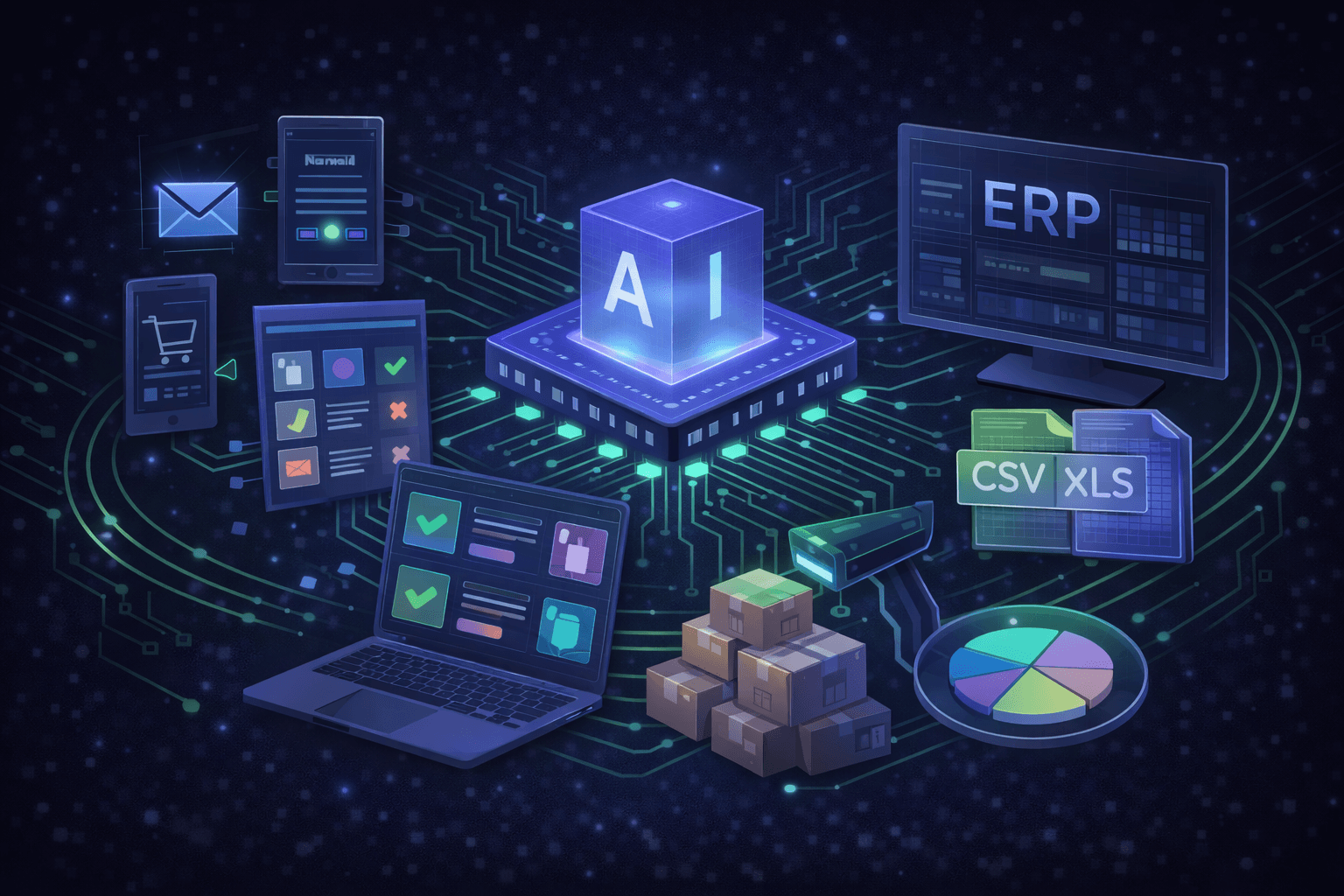
Every order that arrives by WhatsApp, email or a photo of a piece of paper is, potentially, a data-entry error, a dispatch delay or a stock discrepancy. Order intake with AI removes that risk by turning text, audio and images into structured, validated data ready for bulk loading into the ERP, in a matter of seconds.
In this article we analyse the technological fundamentals, the end-to-end automation process, integration with enterprise systems and the implementation criteria for B2B operations that want to scale without scaling the team.
1. Fundamentals of order intake with AI
1.1 Definition and scope of the process
Order intake runs from the arrival of the customer's order to the generation of the order in the system. At B2B distributors and wholesalers, this process concentrates a high volume of daily interactions, heterogeneous formats and multiple failure points: badly coded products, ambiguous quantities, non-existent references or insufficient stock.
AI automation applies across the whole cycle: capture, interpretation, validation, clarification of ambiguities and generation of the final output. The result is an Excel or CSV file compatible with bulk loading into the ERP, with no manual intervention.
1.2 Key technologies: OCR, NLP, computer vision, RPA and machine learning
Four technologies underpin intelligent order intake:
- OCR (optical character recognition): extracts text from images of orders, scanned forms or photos taken on a phone.
- NLP (natural language processing): interprets orders written in free language, recognizes product names with spelling variants and extracts quantities, units and conditions.
- Computer vision: analyses images of lists, labels or physical documents to identify items and quantities with high accuracy.
- Machine learning: continuously improves the model's accuracy from corrections and each customer's historical patterns.
The combination of these technologies makes it possible to process orders in any format, without requiring the customer to change the way they work.
1.3 The problems of traditional management and its bottlenecks
In operations without automation, the manual process generates familiar friction: the rep receives a voice note, transcribes it by hand, looks up the product code in the catalogue, checks stock on another screen and keys the order in item by item in the ERP. Each step is an opportunity for error.
The most frequent bottlenecks are interpreting vague references or product nicknames, reconciling the customer's commercial name for an item with the internal SKU, and verifying stock in real time before confirming. In peak seasons these problems amplify and the team loses operational hours that should be going into selling.
1.4 The main benefits: speed, accuracy, scalability and cost savings
Automating order intake delivers concrete benefits from the first week:
- Speed: the processing time for an order goes from minutes to seconds.
- Accuracy: automatic validation against catalogue and stock eliminates entry errors and later rejections.
- Scalability: the same system processes ten orders or ten thousand without increasing the operational team.
- Cost savings: fewer administrative hours, fewer rejections and less rework translate into a measurable ROI from the first month.
2. End-to-end automation process
2.1 Multichannel capture and unstructured formats
The first step is accepting the order in whatever format the customer already uses. The solution receives text (WhatsApp, email, chat), audio (voice messages) and images (photos of lists, paper forms, screenshots). The customer is not asked to change their channel or their format.
This multichannel capture is decisive in B2B: buyers at distributors and wholesalers tend to send orders from their phone, in informal language, often outside business hours.
2.2 Data extraction and structuring with AI
Once the order is received, the NLP and computer vision model extracts the relevant data: product, quantity, unit of measure, variant and any special condition. This extraction and structuring process turns the unstructured format into normalized rows of data, ready for validation.
The model identifies synonyms, commercial nicknames and partial references, mapping them to the correct SKU in the internal catalogue.
2.3 Validation and data quality assurance
With the data structured, the system automatically validates each item against the catalogue of active products and the stock available in real time. If a product does not exist, has been discontinued or does not have sufficient stock, the system flags it before processing.
Data quality assurance also includes detecting atypical quantities (unusual orders of magnitude for that customer or that product) and verifying the commercial terms in force.
2.4 Clarifying ambiguities before processing
When the system detects an ambiguity it cannot resolve with confidence — a product with multiple references, an unspecified quantity or an item with no stock — it triggers a clarification flow before continuing. The operator or the customer receives a precise question, with clear options, and the order waits until it is confirmed.
This clarification logic avoids one of the most expensive errors: processing an incomplete or incorrect order and discovering the problem at dispatch.
2.5 Fulfilment automation and order generation
With the data validated and the ambiguities resolved, the system automatically generates the Excel or CSV file in the exact format the ERP requires for bulk loading. The output is ready for direct loading, with no manual review, within four weeks of the start of the implementation.
3. Integration with enterprise systems and operations
3.1 Synchronization with ERP, WMS, ecommerce and CRM
Order intake with AI does not operate in isolation: it synchronizes in real time with existing systems. Integration with the ERP makes it possible to query the up-to-date catalogue, prices and commercial terms. The connection with the WMS ensures stock validation reflects real inventory, not yesterday's. Synchronization with ecommerce and CRM centralizes the customer's order history in a single view.
This bidirectional integration is what separates a real automation solution from an isolated capture tool.
3.2 APIs, EDI and middleware for connectivity
Connectivity with legacy systems is achieved through REST APIs, EDI integration for customers with established standards, and middleware where the ERP's architecture requires it. The solution adapts to the existing infrastructure: there is no need to migrate or replace systems in order to implement the automation.
3.3 Inventory, pricing and credit in real time
Every order entering the system triggers a real-time query on three critical variables: inventory availability, the price in force according to the list and the customer's commercial terms, and the available credit limit. This simultaneous verification prevents conflicts that are usually discovered hours or days later, when the order is already committed.
3.4 Exception management and traceability
Orders that do not pass automatic validation do not disappear: they enter an exception management flow with full visibility. The operator sees exactly what failed, why and what action is required. Every interaction is logged with complete traceability: who received the order, which validations ran, what clarifications were requested and when the final output was generated.
4. Implementation, metrics and scaling
4.1 Adoption steps and change management
A well-executed implementation follows a four-stage roadmap: integration with the ERP and catalogue mapping, configuration of the extraction model for the most frequent formats, a controlled pilot with a segment of customers, and progressive scaling with monitoring. Change management includes training the operational team on the new flow and redefining the roles freed from manual work.
4.2 Software selection criteria and architecture
When evaluating solutions, the decisive criteria are the accuracy of the NLP model with the sector's terminology, the flexibility of integration with the existing ERP, the ability to handle multiple input formats without additional configuration, and transparency about how ambiguities get resolved. The architecture should be cloud-compatible and scalable without infrastructure changes.
4.3 Security, compliance and data governance
Orders contain sensitive commercial information: agreed prices, volumes, terms. Data governance means defining who accesses what information, at what level of detail and under what security conditions. Regulatory compliance on B2B customer data requires encryption in transit and at rest, and role-based access control.
4.4 Metrics, ROI and continuous improvement
The key indicators for measuring the impact of order intake automation are:
- Average processing time per order (before and after).
- Data-entry error rate and rejections from incorrect data.
- Percentage of orders processed without manual intervention.
- Operational hours freed per week.
- ROI calculated on the reduction in operational costs and errors avoided.
Continuous improvement rests on retraining the model with the team's corrections and expanding coverage to new formats or channels as they appear.
4.5 B2B cases and operational particularities
In B2B distribution and wholesale operations, the particularities are decisive: catalogues of thousands of SKUs, customers with differentiated price lists, recurring orders with minor variations and buyers working from the field. The AI order intake solution is designed for these conditions: high input variability, high demands on output accuracy.
How nBlock automates order intake
At nBlock we built the order intake solution for commercial teams operating in highly complex environments.
Our application:
- Accepts text, audio and images of orders in any format.
- Interprets and validates each item against catalogue and stock in real time.
- Clarifies ambiguities before processing, avoiding errors downstream.
- Generates the Excel/CSV output ready for bulk loading into the ERP.
- Is implemented in 4 weeks, without replacing existing systems.
The result is a team that stops keying in orders manually and starts spending that time selling, serving customers and growing.
Want to know how nBlock can help your business? Book a demo with our team.
Written by
Manuel Gros
Growth and Sales Advisor
Former CEO of Flokzu and former CRO of Bankingly. Expertise in scaling B2B software companies.
Ready to turn on your first block?
We will show you where the hidden value is in your operation, on your own ERP. No strings attached.
Book a demo →