Operational diagnostic with AI: find the inefficiencies and build a roadmap in 2 days
What an AI-run operational diagnostic is, how it surfaces invisible inefficiencies, and how it turns the team's own voice into a prioritized roadmap.

Gastón Kehyaian
COO
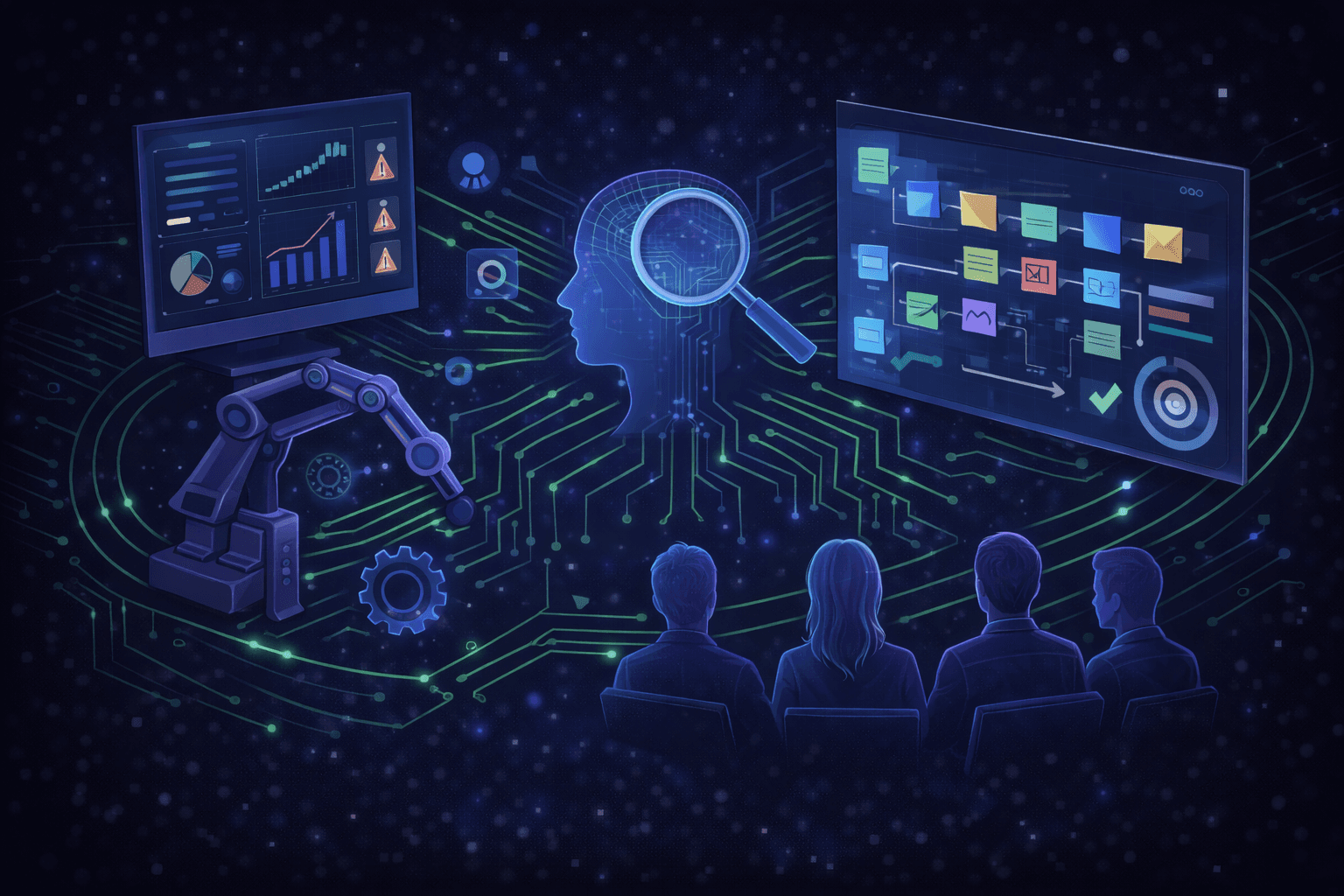
Organizations lose efficiency in ways that are hard to see: duplicated processes, friction between departments, manual tasks nobody questions because "that is how it has always been done". An operational diagnostic run with AI changes that. Instead of relying on outside consultants or static surveys, an AI agent interviews every member of the team, cross-references the patterns and delivers an objective map of where the bottlenecks are and what is worth tackling first.
1. Fundamentals of an AI-run operational diagnostic
1.1. Scope, purpose, and how it differs from a technology audit
An operational diagnostic assesses how the organization works: real flows, day-to-day friction and the time lost between departments. It is not a technology audit — which reviews systems, integrations and technical debt — but an X-ray of the processes people execute every day. The focus is on the team's experience, not on the stack.
1.2. The cost of inefficiency and unplanned stoppages
Every hour of unnecessary waiting, every manual approval and every duplicated task has a real cost: team time, errors, delays for customers and late decisions. Unplanned stoppages — the interruptions that appear when a process depends on another department and nobody has visibility — are especially expensive, because they stay invisible until they cause a bigger problem.
1.3. Digital maturity and operational readiness
Before implementing automation or AI, it is worth understanding where the organization genuinely stands. Operational maturity does not depend only on the tools available, but on data quality, the consistency of processes and the team's readiness to change. A well-executed diagnostic reveals that real starting point, not the idealized one.
1.4. Operational usefulness versus technical metrics
The success of a diagnostic is not measured by the amount of data gathered, but by the usefulness of its conclusions to the people who have to make decisions. Technical metrics matter, but what transforms an organization is knowing exactly which process to invest in first, and why.
2. Components and enablers of the diagnostic
2.1. Processes, bottlenecks and operational friction
The starting point is mapping how work flows: from the moment a task originates to the moment it closes. Bottlenecks tend to appear at hand-offs between departments, in processes that require manual sign-off, or in tasks that depend on information scattered across places. Operational friction is cumulative: small delays add up to significant losses over a month.
2.2. Data and information quality
A useful diagnostic requires reliable data. That means assessing what information exists, where it is stored, how current it is and who has access to it. Data quality is a critical enabler: without consistent information, any automation built later would just reproduce the errors already there.
2.3. End-to-end workflows and system integration
Real processes rarely live inside a single system. They cut across the CRM, the ERP, spreadsheets, email and chat conversations. Understanding those end-to-end workflows — and how the systems integrate, or fail to — is essential to identifying where automation creates the most impact.
2.4. Governance, risk and compliance
Any AI initiative has to account for who approves what, how sensitive data is handled and which regulatory constraints apply. An operational diagnostic includes a governance review so risks are anticipated before implementation rather than after it.
2.5. Team capabilities and change management
The most sophisticated technology fails if the team does not adopt it. The diagnostic assesses the team's current capabilities, identifies skill gaps and anticipates where resistance to change will concentrate. That makes it possible to design an implementation with real support behind it, not just documentation.
3. Applications, benefits and evidence of impact
3.1. Prioritizing by criticality and impact
Not every problem deserves the same attention. An AI-run operational diagnostic orders the findings by frequency and impact: which processes repeat most, which cost the most when they fail, and which affect the customer experience. That prioritization matrix is the basis of the roadmap.
3.2. Cross-cutting and sector-specific use cases
The most common inefficiencies show up in operations (approvals, reports, follow-up), in sales (CRM updates, quoting, lead follow-up) and in administration (invoicing, reconciliations, onboarding). In sectors like retail, logistics or services the friction patterns are similar, even though the context varies.
3.3. Expected benefits: efficiency, availability and quality
A well-executed diagnostic makes it possible to cut process times, eliminate work with no added value and improve the availability of information for the people making decisions. Operational quality rises when teams stop managing errors and start working on genuine exceptions.
3.4. Measuring results and continuous feedback
The diagnostic is not a one-off event. Repeating it periodically makes it possible to measure progress, detect new friction that emerges with growth, and assess how the team has taken up the tools that were implemented. Operational improvement is a cycle, not a closed project.
4. Running an operational diagnostic with AI
4.1. Steps and deliverables: the initial snapshot and the roadmap
The process starts with structured interviews with every person on the team. An AI agent runs sessions of 15 to 30 minutes, analyses the patterns across departments and produces two concrete deliverables: an initial snapshot of the current operational state and a roadmap prioritized by impact and frequency. All within 2 days.
4.2. Selecting and assessing vendors
A good operational-diagnostic vendor needs experience with real processes — not only with technology — a structured interview methodology, and the ability to translate findings into actionable recommendations. The proposal should include clear deliverables, not just general reports.
4.3. MLOps, automation and orchestration in production
Once the opportunities are identified, the next step is automating the processes that were prioritized. That means designing the workflows, connecting the systems involved and defining how the automated tasks are orchestrated in production. MLOps infrastructure is what keeps the models current and monitored.
4.4. Alerts, interpretability and adoption inside the workflow
Automations have to be transparent to the team. That means comprehensible alerts, traceability of decisions and mechanisms for people to step in when they need to. Adoption is not a communications problem: it is a design problem.
4.5. Common risks and how to mitigate them
The most frequent risks in an operational diagnostic are: bias in the interviews when confidentiality is not guaranteed, findings that are not prioritized correctly, and roadmaps designed without accounting for the team's real capacity to execute. Anticipating them from the start is the difference between a diagnostic that gets used and one that ends up in a drawer.
Why nBlock for your operational diagnostic
At nBlock the operational diagnostic is run by an AI agent that interviews each person on the team individually, in sessions of 15 to 30 minutes. The agent analyses the patterns across departments, detects problems that are not visible from any single role and produces a roadmap prioritized by impact and frequency. The whole process takes 2 days.
What sets it apart:
- The team's voice as strategic input. People speak freely because the agent has no place in the internal hierarchy and no political agenda.
- It detects problems that are invisible between departments. The most expensive bottlenecks tend to sit at the edges, where nobody has full visibility.
- An objective basis for deciding where to invest. The roadmap does not reflect a consultant's opinion; it reflects the patterns that emerge from the whole organization.
- Periodic follow-up included. At set intervals the diagnostic is repeated, to measure how the team has taken up the tools, identify new opportunities and keep the improvement continuous.
Want to know how nBlock's operational diagnostic would work for your team? Book a demo and we will go through it together.
Written by
Gastón Kehyaian
COO
Over 20 years of executive experience in management, finance and digital transformation. MBA, MND, specialist in digital transformation.
Ready to turn on your first block?
We will show you where the hidden value is in your operation, on your own ERP. No strings attached.
Book a demo →